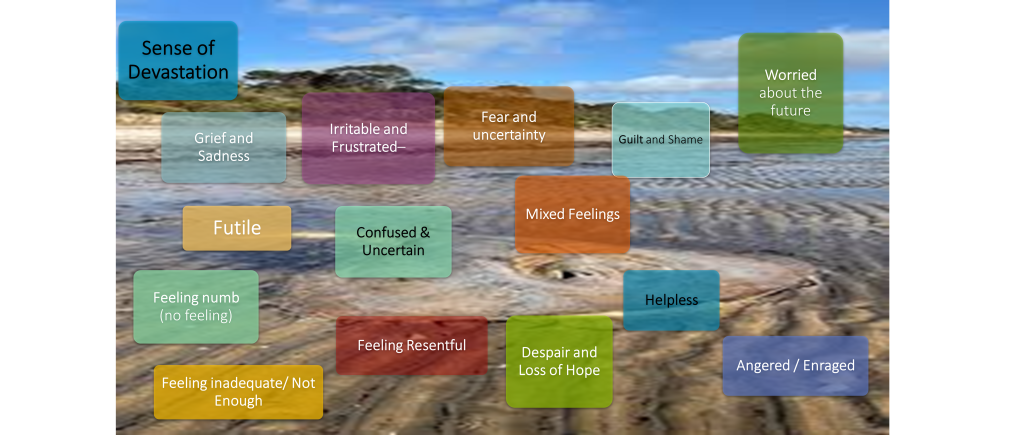
TONE DOWN OUR EMOTIONS
Sometimes our emotions are so big, or intense, confusing or overwhelming that we just need to start by trying to calm and steady them. Ways we can do this include:
- BREATHING
- GROUNDING & REREGULATING OUR NERVOUS SYSEM THOUGH THE SENSES
- REBALANCING THROUGH NATURE EXPERIENCES

MOVE THROUGH OUR EMOTIONS
Sometimes, the most useful place to start with helping with our emotions, is to engage in exercise and recreation. Not only do we burn off the excess adrenaline that emotions can bring with them, but we help balance changes our state though the release of endorphins, as well as through the shift in our attentional focus.

EXPERIENCE OUR EMOTIONS
Other times, when it is appropriate, we may need to give our self time alone or even with others, where we allow ourselves to feel all of our feelings. In this way we can start to move beyond them over a period of time. So how do we ‘feel our feelings’? We can start by accepting them, then allow ourselves to experience them within our bodies before moving onto recognising and naming them.

- UNDERSTAND IT
- To understand our emotions, it can be helpful to conceptualise why we have emotions in the first place. We can think of an ‘e-motion’, as energy-in-motion, or as a short, wave like sensation, or series of responses in our biology, that temporarily moves though our nervous system.
- Once allowed and felt, this energy-in-motion can move us into action. It it important to hold the awareness that the emotion may ‘in some ways feel’ uncomfortable as it is experienced, but if we allow the sensation of it to pass, with acceptance and without judgment or a ‘story’ attached to this emotion, it will help us move to a new state of being. This can leave us more balanced, and allow us to feel more energised for new or more decisive or productive action.
- ACCEPT IT
- We try to understand that emotions pass, have a wave like nature, they peak and then settle, and they actually help us move to feel more balanced and calm.
- FEEL THE SENSATION OF IT
- Often the best place to start, is to find a quiet, safe space and be open to noticing and experiencing whatever sensations arise within our bodies, without judging that experience.
- NAME IT TO TAME IT
- We try to understand that if we can link what we are feeling with words, describing these inner states, we can ‘code’ or integrate our emotions much more effectively.
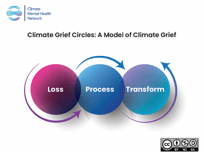
GRAPH SOURCED THROUGH THE CLIMATE MENTAL HEALTH NETWORK.
SHARING OUR FEELINGS (CO REGULATING)
Where we have the opportunity and feel comfortable to do so, it is often really helpful to talk to another person about our feelings. However, if this is not your usual style, then it’s also helpful to just take some quiet time to ‘be with’ our feelings, perhaps even journaling these feelings. What is most important is that we are willing to experience our feelings just as they are, allowing ourselves to be vulnerable, and not making the feelings wrong or right. All feelings are valid in this large scale, unfolding crisis.

THE BENEFITS OF FEELING OUR FEELINGS
When allow ourselves to feel our feelings, we ‘process’ our feelings. In this way, only do we often feel lighter in our bodily states, but we can find that we have more space and energy to focus on moving into positive mood states, as well as constructive or meaningful action – that can further benefit our wellbeing.
References
Cunsolo, A., Harper, S. L., Minor, K., Hayes, K., Williams, K. G., & Howard, C. (2020). Ecological grief and anxiety: The start of a healthy response to climate change? The Lancet Planetary Health, 4(7), 261–263. https://doi.org/10.1016/s2542-5196(20)30144-3
Fritze, J., Blashki G.A., Burke, S., & Wiseman, J. (2008). Hope, despair and transformation: Climate change and the promotion of mental health and wellbeing. International Journal of Mental Health Systems, 2(13).
Moser, S. C. (2007). More bad news: The risk of neglecting emotional responses to climate change information. In S.C. Moser & L. Dilling (Eds.), Creating a Climate for Change: Communicating Climate Change and Facilitating Social Change (pp. 64–80). 1st ed. Cambridge: Cambridge University Press. Cambridge Books Online.
 Algal Bloom Wellbeing Resources