And, for many people, this can come with a whole range of thoughts and feelings.
Related emotions can include strong (almost unshakeable) sadness and grief, fear and worry about the future, frustration and anger at the historic lack of action to prevent climate change, even helplessness and a general niggling sense (even in our bodies) that something ‘just isn’t right’.
Climate Emotions can be:
- many and varied
- often changing
- strong and sometimes complex
- normal and increasingly common
- lonely (when we’re not sure if others feel the same)

Chart sourced from the Climate Mental Health Network
CLIMATE DISTRESS IS NOW COMMON
In Europe this summer, with ongoing climate-related environmental conditions of extreme heat, fires and crop failures. Research estimates that:
- As much as 15% of the population of some countries are experiencing significant levels of anxiety about climate-change.
- Approximately 80% of Europeans have changed their holiday plans due to climate-related factors.
It is very possible that if the algal bloom continues to impact South Australian beaches over the summer (with large parts of the community experiencing heat, as well as restricted beach use, financial, recreational, health and cultural impacts), we could experience similar rates of climate distress here.
It can be challenging coming to terms with all of these feelings and to find ways to live our best lives alongside them.

THINKING ABOUT CLIMATE EMOTIONS
If you are feeling impacted by these climate concerns, you are not alone. Many feelings are now common, real and valid.
Eco grief is the term that is commonly being used to describe the sadness and sense of loss at the natural world’s destruction and harm.
Eco anxiety is a way of describing fear about the future of the natural world as climate change continues to occur, as well as the expected loss that could occur in the future – to the natural environment, it’s living creatures and eco-systems.
There are a whole range of ways people can experience their feelings about climate change.
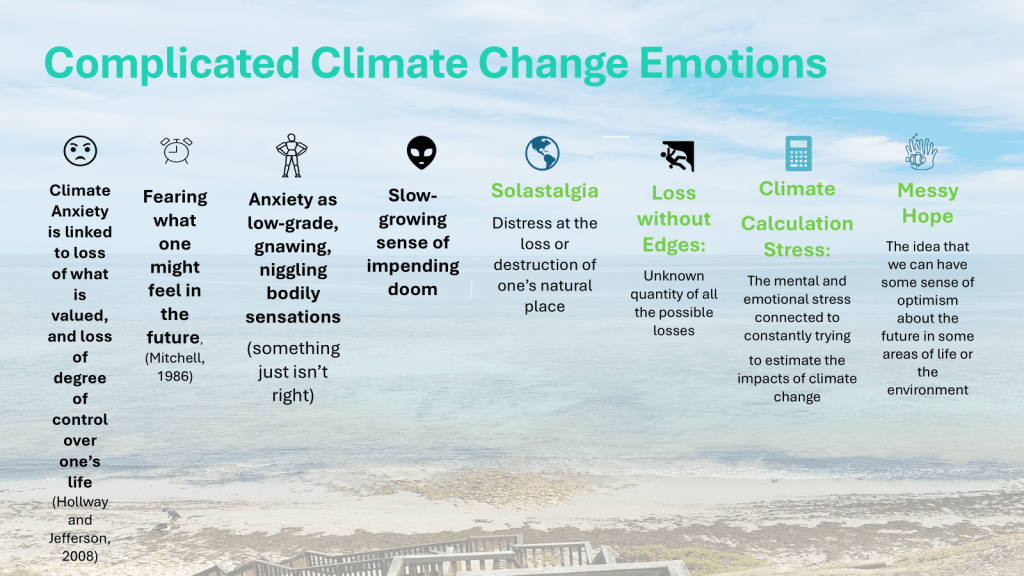
Here is a table that outlines some of the ways Climate Distress can be described:

Table: Suggestions of nuanced descriptions of some terms related to climate distress (Pihkala, 2023, 25)
CLIMATE EMOTIONS ARE COMPLEX
Solastalgia is a term being used more and more to describe the distress at the sense of loss and destruction of the place or environment which we are strongly connected to.
It is a sense of homesickness for a place we haven’t left, that is dying or being destroyed whilst we are still living in this environment.
Loss Without Edges. Another term that may be especially useful when thinking about climate change as it connects to the current algal bloom crisis – is ‘loss without edges‘. That is, a sense that we are grieving for something that we don’t know the extent of.
It’s difficult to know just how much marine life and ecology has been lost and destroyed, or how long this crisis will go on for, and what the future of this crisis will look like.
Climate Calculation Stress: This sense of an unknown quantity of change and potential loss (in the past, present and future) can result in a heavy mental burden. There is a kind of Climate Calculation Stress that can come with trying to estimate, predict and generally imagine all of this destruction and change.
Messy Hope. Not all emotions about climate are negative. ‘Messy Hope’ is the idea that although things may seem chaotic and uncertain, there are things that can still be hope for.
In fact, research suggests that if we can hold the hope, even for constructive projects or outcomes in our local environment or community, we are more likely to be able to manage our climate distress.
Some additional ways of conceptualising climate distress.
HOW ARE YOU TRACKING WITH CLIMATE ANXIETY?
Have you been concerned that things in the natural world are out of kilter or on edge?
CLIMATE ANXIETY TEST (3 Min Survey, PSYCHOLOGY TODAY)

MANY DIMENSIONS TO CLIMATE EMOTIONS
Climate emotions can:
- cluster and be tied together
Climate feelings can be hard to separate from each other. For example, for many it is hard to separate out feelings of sadness and solastalgia from a sense of worry about the future. - be multi-pronged
There can be many aspects to one are of climate concern. For example, worry about threats to future generations can include concerns such as about future livelihoods and lifestyles, as well as to the future of the environment and living creatures. - become fused with a sense of time and generational difference
In general, research is showing that young people may be more aware of ‘tipping points’ and a ‘finite’ sense of time to act, as compared to older generations. They may also be more aware that their anxiety is higher than generations who will not face as much direct impact within their lifetimes. - be coupled with strong sense of isolation
Many report feelings a strong sense of being alone and isolated with their feelings of climate distress, with many not realising that there are many others who also have significant concerns. - be constantly changing
- Climate emotions can keep changing as we talk to others, experience changes in the natural world and learn more from science.
“No one ever told me that grief felt so like fear” — CS Lewis

COPING WITH CLIMATE DISTRESS
When people feel a high level of distress relating to current and future impacts of climate change, it can affect:
- day-to-day mood
- interest in pleasurable activities
- concentration and memory
- sleep, energy and appetite
- work productivity
- sense of sociability
Strong feelings are normal and valid, but it is still important to take active steps to manage these effects.
Further Support for Eco-grief and Anxiety
Climate Cafes are an especially useful online support for climate distress. They are chat circles, open to anyone, anywhere in Australia, and are run through different organisations. Learn more:
Watch: Psychology For a Safe Climate Climate Cafes
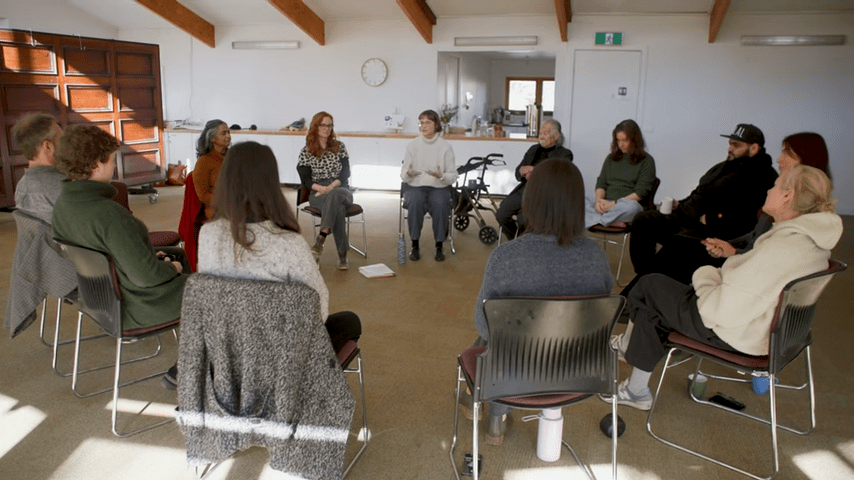
Surfers for a Safe Climate – also now have Reef Grief Cafes for people particularly connected to the coast through the love of nature and / or recreation.
Council Wellbeing Workshops: Some councils have started running free wellbeing workshops designed to help community members cope with the emotional impacts of the bloom, including learning personal resilience skills and connecting with other people and projects. Look out on your council events sites or contact your local council to enquire.
Other Resources:
More Inspiration for Climate Coping
Podcasts
- One Wild and Precious Life (Sarah Wilson)
- How to Work with Eco Anxiety and Climate Grief
- We are the Great Turning
- A Matter of Degrees
- Anthropause
- Outrage and Optimism
- How to Save a Planet
- Big Sky Country
Books:
- Facing the Climate Emergency: How to Transform Yourself with Climate Truth (M Klein Salamon)
- Climate Anxiety: A Field Guide, By Sarah Jaquette Ray
- How to Change Everything, By Naomi Klein
- Power, By Dr. Shalanda Baker
- The Care Manifesto, By The Care Collective
- Saving Us, By Dr. Katharine Hayhoe
- Generation Dread, By Britt Wray Gesturing
Online Groups & Forums
- Deep Adaptation Facebook group
- Algal bloom Facebook groups: Surf and Bloom, Algal Bloom Disaster.
- RecFish and Oz Fish and other online community groups
Articles
- Eco-Anxiety: What it is and Why it Matters
- How to Build Mental Resilience in a Changing Climate
- The Psychological and Emotional Benefits of Getting Outside
- How Nature Restores Our Minds
- Their Resilience is a Lesson to Us All
SUMMARY OF COPING
- Don’t dismiss your complex climate emotions, they are valid and understandable
- Give your feelings space and time to process
- Allow/try engaging in conversations with others
- It is powerful to connect with nature, even if this can be heart-breaking at times
- Consider using art or other creative methods, even ancient or spiritual practices, to express your thoughts and feelings about climate-related things
- Don’t try to replace them with positive emotions, but positive emotions can be a part of the bigger picture
- Don’t centre on Doom and Gloom (even if this is part of your valid feelings), instead centre on solutions-focused actions and outcomes
PRACTICAL ACTIONS YOU CAN TAKE TO FIGHT CLIMATE CHANGE
There are actually a whole range of actions you can take to help be involved in carbon reducing action, and in doing so, help lower your own climate-related distress.
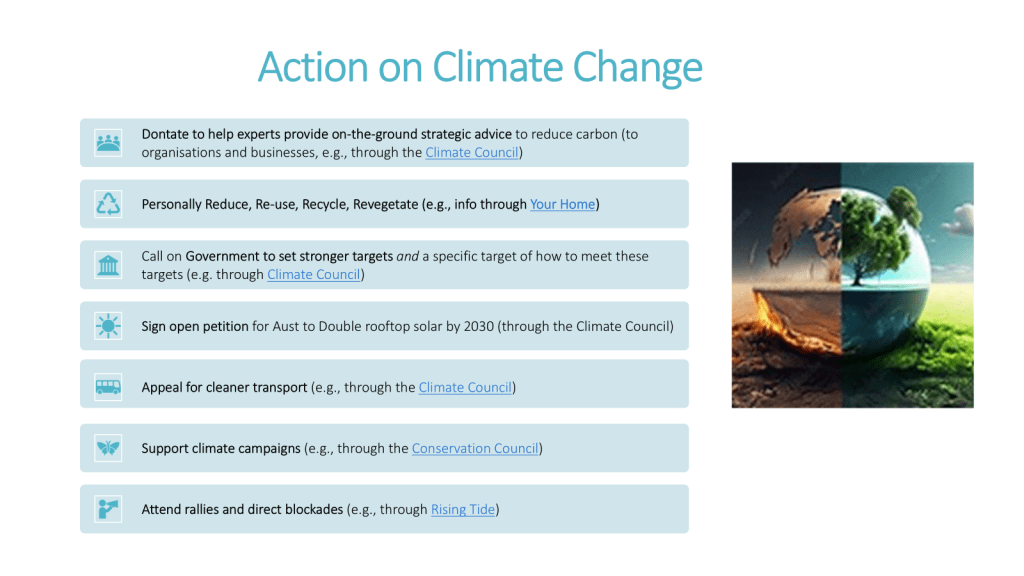
Here are more suggestions. It is not an exhaustive list. There many groups and projects that you can become involved in.

Engaging in Art: Helping with Complex Climate Experiences
Research is increasingly showing that art can be a very important tool for ‘coming-to-terms’ with climate emotions. Doing art can help us:
- link up all the complex feelings and layers of experience within us about climate change
- express what’s hard to express with words
- interpret and reflect on climate research
- tell climate stories
- transform negative emotions into more uplifting and energising ones
- process climate trauma and collective grief
- imagine better futures
- build a sense of being connected to something bigger than ourselves
- feel less alone
- find meaning and purpose through creating
- inspire ideas and positive action
(Adapted from Climate Doom to Messy Hope: Climate Doom to Messy Hope, Wise 2022).
ALGAL INSPIRED ART
Here is a poem written by a local community member, which speaks to many of the points above:
Listen Here:


Here is music produced by local artists during the algal bloom as part of their journey to come terms with all the ecological destruction
- God Speed You Algal Bloom (The first pic was taken the Fri night before it all started when I rinsed myself off at Parsons after a dirty surf at Middleton. The second pic is a surf report for my fave break)

Personal Reflections: Being Involved in Community Art During the Bloom
Here are some personal reflections from local people who were involved with art activities, during the Toxic Surf Community Project:
‘Great workshop! Well needed for the community….This workshop helped me express my concerns about the Algae Bloom. It also was great community spirit to get together and talk about what’s happening in our community’
‘It was an awe-inspiring event which lasted long with me – especially working alongside a Frist Nations person and very experienced facilitators of our mental health. The workshop generated further creative writing and enhanced my ongoing involvement with the issues…..A meaningful community gathering to experience cathartic moments together, to create art and lift our spirits toward hope and healing.’

PERSONAL ART ACTIVITY
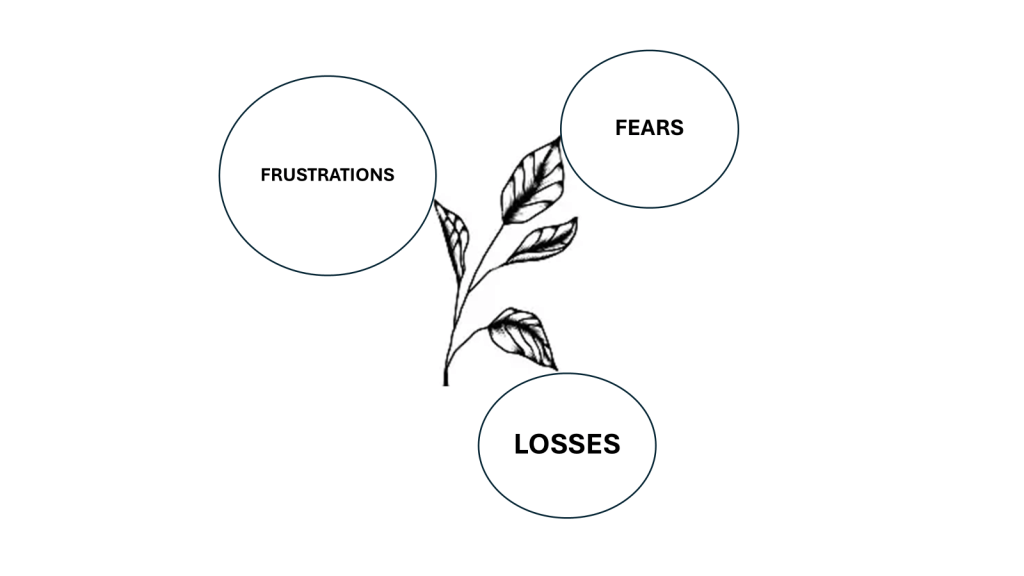
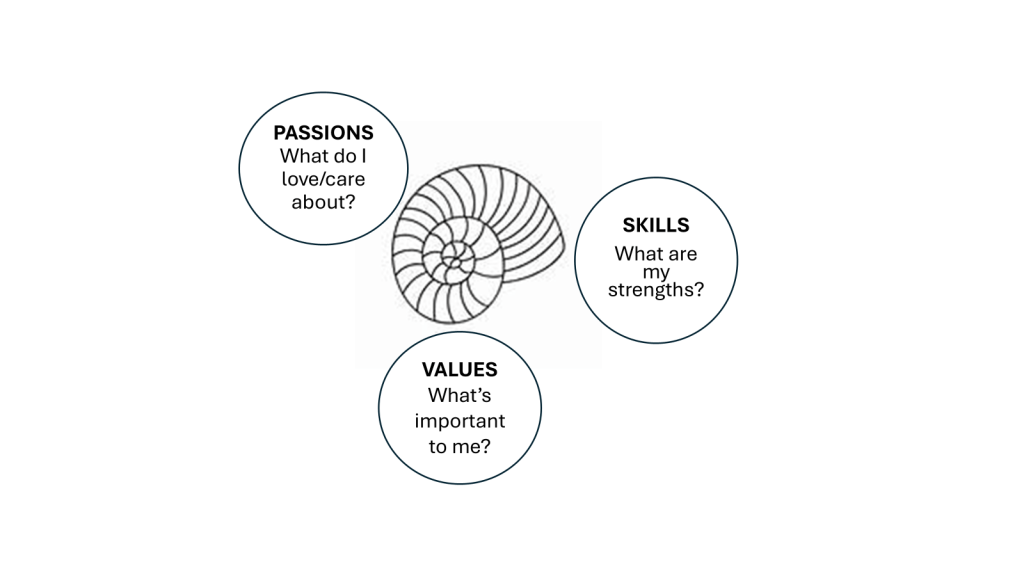
Here are some art sheets that can be used as prompts, to help reflect on feelings and what’s important, in relation to the ocean, nature and climate change.
They can be completed with words, colours, images and any materials desired. This is an invitation to explore feelings and ideas in a different way than might be usual.
CONNECTNG TO NATURE TO HELP WITH CLIMATE EMOTIONS
There is now also evidence that connecting to nature, either simply by spending time in nature or by being involved in projects that care for nature, is also particularly good for managing climate distress.
Even being connected through nature immersion, nature visualisation, personal gardens, indoor plants and doing art with natural materials can have wellbeing benefits.

FURTHER RESOURCES and INSPIRATION
Guided Visualisation
- Earth Journey Meditation for Deep Relaxation
- Guided Meditations: Health and Psychology
- Sit Spot Nature Connection Meditation
Articles on Nature Connection
Forest Bathing
FOR MORE INFORMATION AND RESOURCES ABOUT COPING THROUGH NATURE CONNECTION, go to: Wellbeing Strategies.
REFERENCES
Aldoh, A., Ungureanu, R., & Popescu, S et al. (2025). How multisensory nature exposure affects well-being: Visual and auditory influences on affect. People and Nature. https://besjournals.onlinelibrary.wiley.com/doi/10.1002/pan3.70157.
Cunsolo, A., and Ellis, N. (2018). Ecological grief as a mental health response to climate change- related loss. Nature Climate Change 8, 275–81.
Rafa, N., Zabala, A. Galway, L. P. (2025). Empirical research review on Solastalgia: Place, people and policy pathways for addressing environmental distress. (2025). British Ecological Society, People and Nature,
Foong, L. H. & Huntly, R. (2021) Communicating about climate change – Who is listening, who isn’t and why: Implications for medical professionals, Journal of Paediatric and Child Health.
Frank, E. (2025). Ambiguous Loss: Navigating Loss without Closure. eNotAlone.
Goodwin, J., Jasper J. M., and Polletta, F. (2001). “Introduction: Why Emotions Matter” in Passionate Politics: Emotions and Social Movements. (1st ed). Edited by Jeff Goodwin, James M. Jasper, and Francesca Polletta. 1-24. Chicago: The University of Chicago Press.
Kelman, I. Measuring Eco-anxiety, or not. Examining scales and indices for trauma from environmental change. Psychology Today.
Kurth, C. & Pihkala, P. (2022). What is eco-anxiety and why it matters. Front Psychol 2022 Sep 23;13:981814
Le Busque , B., Litchfield, C., & Shaw, C.L (2024). Exploring the indoor plant-people relationship through qualitative responses, Plant-Environment Interactions vol. 5, no. 6, article no. e70025, pp. 1-6
Molsher, R. (2022). SA NATURE PRESCRIPTION TRIAL 2021 Final Technical Report, Green Adelaide in Partnership with Appleton, Published online in February 2022 at http://www.greenadelaide.sa.gov.au
Pearson, E., Richardson, A. & Le Busque, B. (2024). Fostering psychological literacy and student well-being through the first-year course connecting and working with nature: a case study’. Psychology Learning and Teaching, Vol 23, No 2, pp. 129-340.
Ray. S.J. (2020). A Field Guide to Climate Anxiety: How to keep your cool on a warming planet (1st ed.). University of California Press.
Rubab, T., Noureen, S., & Manzoor, A. (2024). Evaluating the Societal Impact of Climate Change on Mental Health: Heat-Related Stress, Anxiety, and Depression in Vulnerable Populations. Contemporary Issues in Social Sciences and Management. Volume 3, Issue 2, June 2024, Pages 151-164
Soutar, C., & Wand, A. P. F. (2022). Understanding the Spectrum of Anxiety Responses to Climate Change: A Systematic Review of the Qualitative Literature. International Journal of Environmental Research and Public Health, 19(2), 990. https://doi.org/10.3390/ijerph19020990
Vela Sandquist, A. V., Biele, L., Ehlert, U., & Kischer, S. Is solastalgia associated with mental health problems? A scoping review, (2025). BMJ Journals Mental Health.,
Wise. M. (2022). Climate Doom to Messy Hope: Climate Doom to Messy Hope: Climate Healing & Resilience Climate Healing & Resilience: A Practical Handbook for Climate Educators and Community Climate Educators and Community
Zahniser, A (2025). Why is psychology important in communicating effectively about climate change, and how can we tap in? Article in Climate Steps.
DL Wolf, K. L. et al. Urban trees and human health: A scoping review. Int J Environ Res Public Health 17 (2020). https://doi.org/10.3390/ijerph17124371
Exploring the indoor plant-people relationship through qualitative responses
Moser, S. C., & Boykoff, M. T. (2013). Climate change and adaptation success: The scope of the challenge. In S.C. Moser and M.T. Boykoff (Eds.), Successful Adaptation to Climate Change: Linking Science and Policy in a Rapidly Changing World (pp. 1–33). New York, NY: Routledge.
Pihkala, P. (2024). Definitions and Conceptualizations of Climate Distress: An International Perspective. In E. Haase & K. Hudson (Eds.), Climate Change and Youth Mental Health:
 Algal Bloom Wellbeing Resources
Leave a comment