On top of this, there are many people who are also experiencing a range of health, financial, cultural and lifestyle impacts of the bloom.
Given all that is going on, it’s common and normal to be struggling with the mental and emotional toll of it.
Here’s a few ideas, based on research, for ‘getting through’ this challenging time.
This information has been put together by local mental health professionals and wellbeing experts (in consultation with the community).
Within this portal, there are also links to further resources and support.
Emotional Reactions: The Bloomin’ Bloom
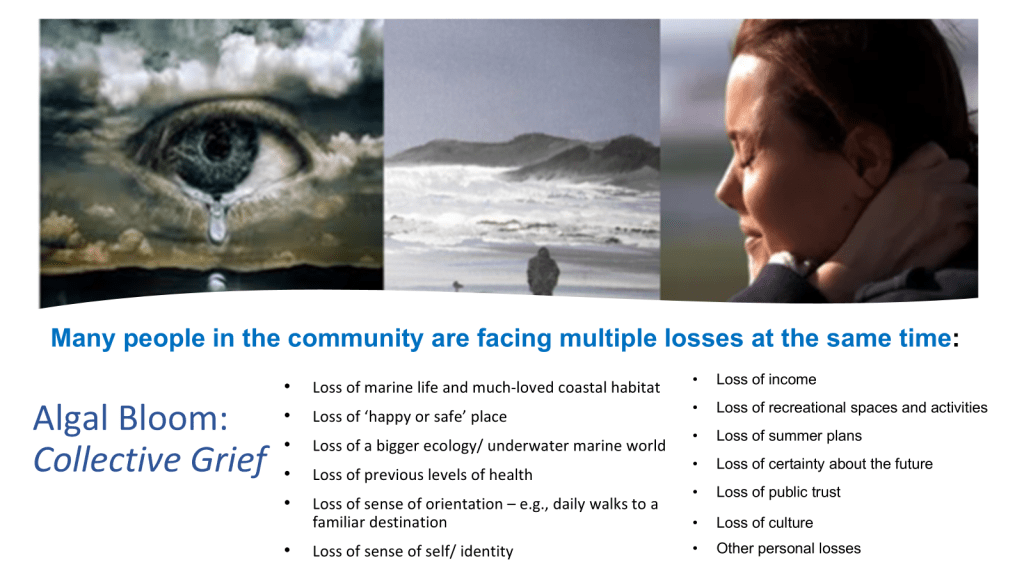
Many people are experiencing several different losses at the same time, and know others who are also impacted in many different ways.
Being aware of all the impacts on marine life, to other people we care about and the community at large, can take a toll on our well-being.
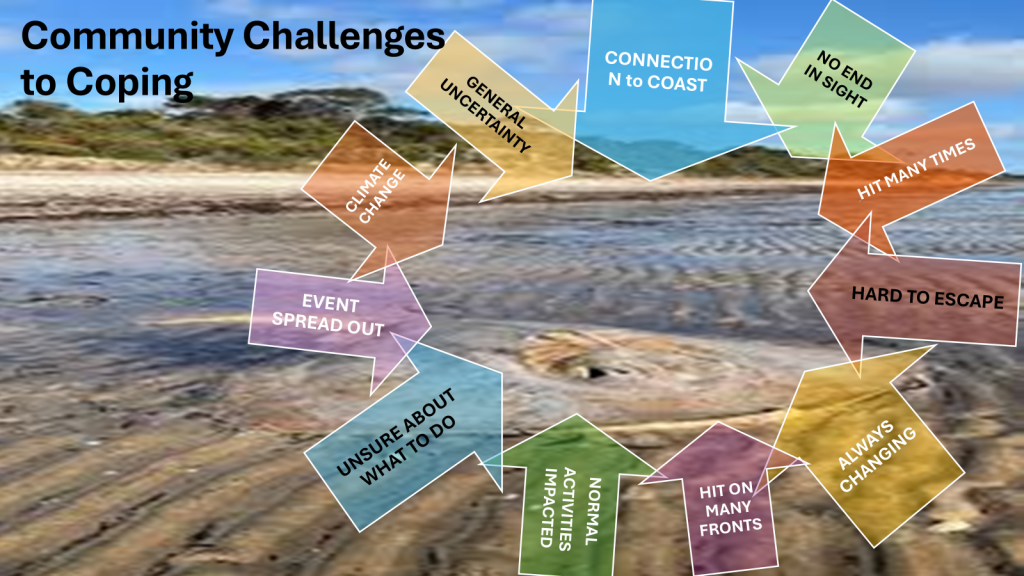
There is no definite end in sight and coastal conditions are constantly changing – from the impacts on the marine life, to what we are experiencing with our senses.
There are also many unknown and constantly changing impacts upon our health, lifestyles, livelihoods and cultural practices.
Many of us feel quite uncertain about what action we can take to protect ourselves, as well as our environment.
Many of us also find ourselves thinking a lot more about the broader issues of climate change and future environmental protection.

Therefore, many different strong, mixed and often changing emotions are understandable and normal at this time.
These can range from deep sadness, frustration and anger, to fear and overwhelm, and even a sense of mistrust or injustice.
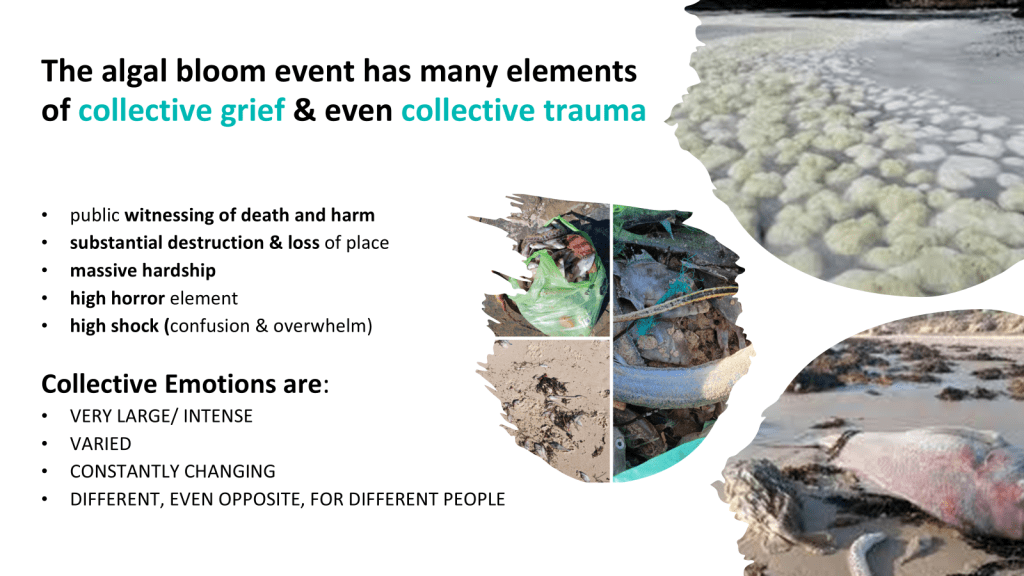
For some, this algal bloom might even be experienced as a collective trauma.
Many of us are repeatedly sharing the experience of all the distressing, even horrifying, scenes of dead and dying marine life and coastal habitat, as well as hold knowledge about hardship for many community members, including many people who we are close to.
For more detail about emotional reactions go to:

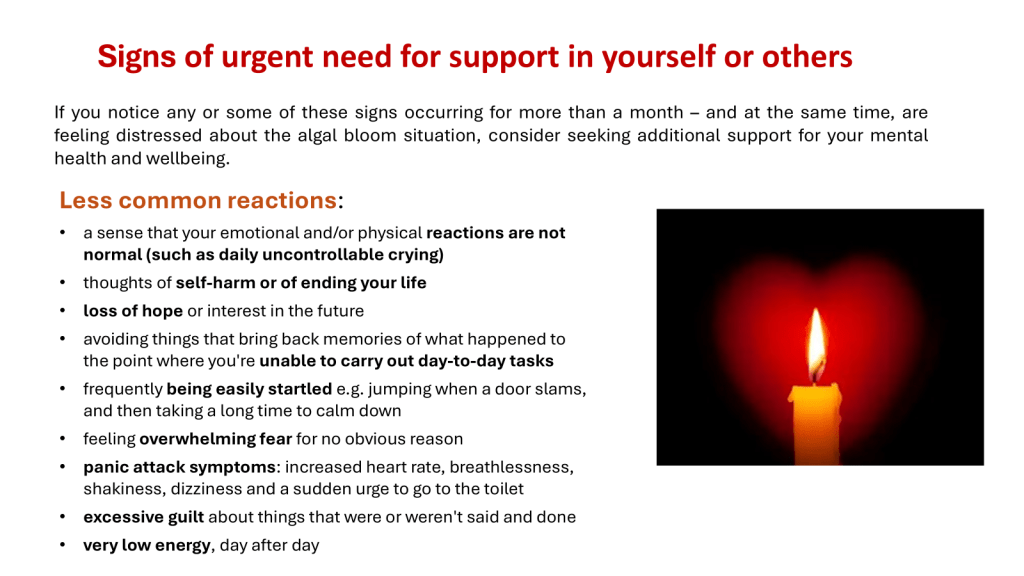
So it is important that we are on the lookout for physical and emotional signs that signal we are too stressed and overwhelmed by all that is happening.
Some of the clear signs include:
- feeling constantly restless & keyed up
- more tired or flat in our mood & interest
- more difficulty than usual with concentration
- sleep disturbance
- irritability and/ or increased conflict
If we have been experiencing at least several of these signs for weeks or months, it is important to for our longer-term health to take active steps to support our wellbeing.
Thoughts, Feelings, Actions
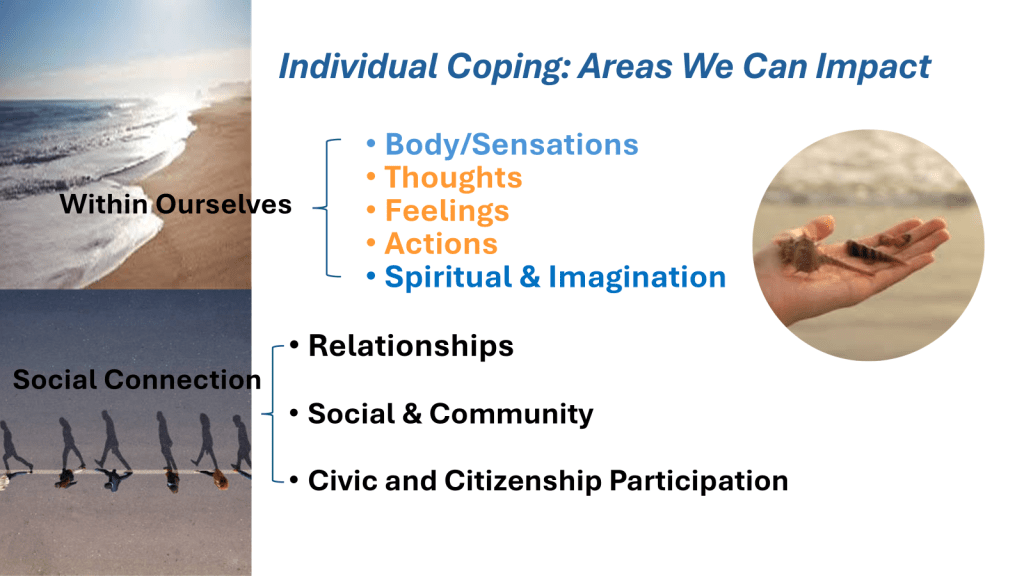
We can consider whether there is anything we can add in, or do differently, in various areas of our functioning. For example, in the ways we think, feel, or act, to improve how we’re currently coping during this bloom.
Taming the Algal Gloom

We can consider:
- Are we noticing any ‘extreme-themes’ in the way we are looking at things?
- And if so, can we find slightly more ‘balanced’ and less simplistic ways of thinking?
- Are we directing our attention and energy to the things we can control, rather than all of the things that are currently out of our control within this situation?
- Taking ‘micro-actions’ or setting mini-goals and routines (that are specific and achievable) can be a good way to get ‘unstuck’ from a sense of emotional overwhelm and inaction.
- Finally, a particularly useful strategy is spending time focusing our attention upon things that are easy to focus on and also pleasant to our senses (especially if we’re feeling low in concentration and high in restlessness).
- Psychologists call this being‘softly fascinated’ in a healthy way. For example, we can do it when we are out on walks in nature, or listening to music.
- Find more detail and resources: Well-being Strategies.
Transforming Algal Emotions
Recent eco-psychology research has found that when we are experiencing high distress about environmental issues (that are not easily or quickly fixable), it can be very important to give extra attention to our feelings.

That is, to noticing them, accepting them, maybe putting words to them and allowing ourselves to ‘feel them’ in our bodies. We may need to take extra time and space for this, and, where we can, sharing these feelings with trusted others.
This can actually help us ‘move through’ them, so that we feel lighter in our bodies, clearer headed and more ready to take constructive action.
For more info: Emotion Focused Coping .
Our Sea Self-Care
As well as considering how we are managing our thoughts and feelings, we can also add more small, daily practical self-care strategies, .

For example, breathing with a shorter inhalation and longer exhalation is an excellent way to quickly feel calmer.
Paying attention to small positive things can also quickly improve our mood. We can find 3 good things in our life to be grateful for or ‘notice 3 nice things‘ around us in our daily life.
Finally, it’s really important that we consider whether and how we are connected to things that matter.
More self-care tips and guided relaxation links Well-being Strategies.
Coping through Connection
Of those things that matter, research highlights that staying connected to others through times of crises is really important.
Consider first whether there are any ways we can improve the quality and depth of the connections we already have in our personal lives.
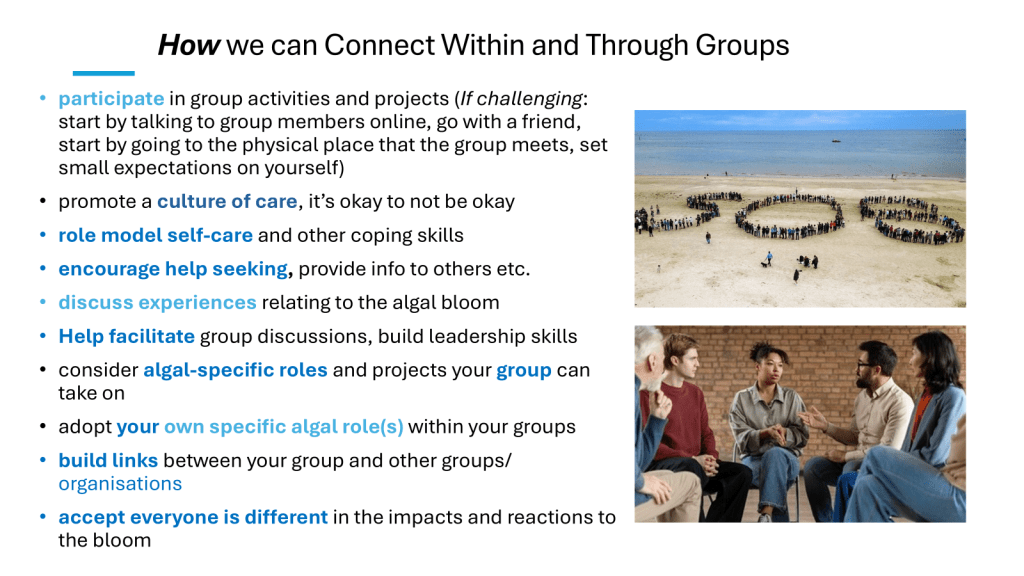
Not all of us have big and busy social networks, but perhaps we can connect more with a neighbour, a local shop owner, or even in online community forums.
We can also look to increasing our involvement in groups, as well as improving the quality of our experiences within these groups.
What’s important, is fostering a culture where it’s okay to not be okay, perhaps feeling comfortable to voice that we’re having a rough day or struggling with the algal situation (and, by the same token, provide an understanding ear for others).
Improving the quality of our group interactions might also mean looking for more opportunities for fun, lightness and humour at this time, as well as helping to create spaces for talking to others about how we’re feeling.
Many people report being pleasantly surprised at how open and receptive others are to having these conversations at the moment.
But it is important to be aware that as the crisis drags and realities ‘hit home’, community members could also become more ‘irritable’ and divided (as happened during the COVID pandemic). So making a conscious effort to ‘step out of the wrestling ring’ -avoiding unnecessary conflict – will also be important.
More info about social and group connection can be found on the Well-being Strategies page.

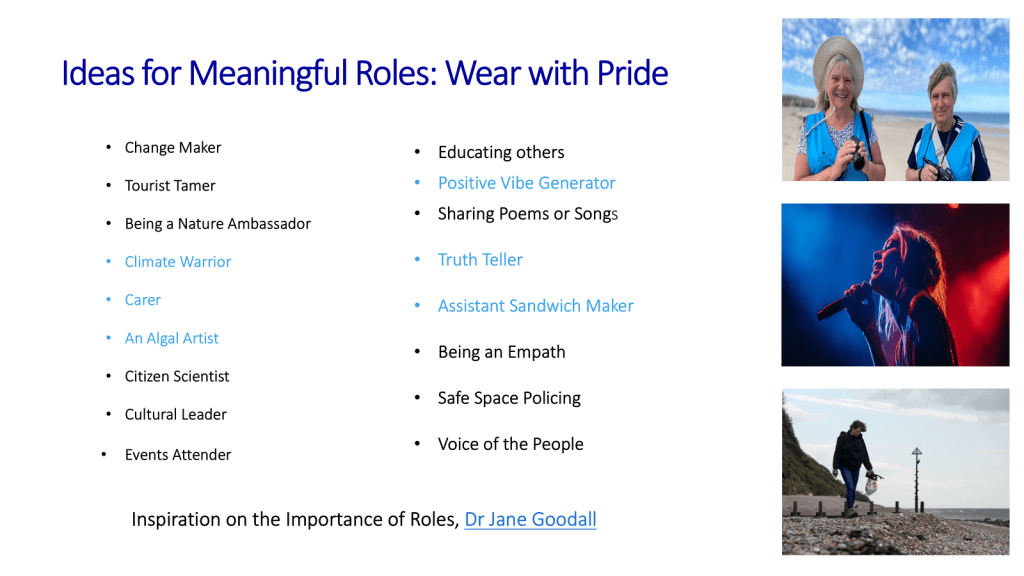
There is some new research showing that getting involved in positive group projects or volunteer roles, is not only helpful for the community, but also great for our own well-being (as a way to manage our eco-grief and anxiety).
This may be especially true for younger adults in helping them deal with a sense of despair or distress about environmental and climate-related concerns.
For links to community groups and projects, go to Actions You Can Take
Finding Purpose and Meaning
New research in the field of eco-psychology highlights the importance of ‘meaning making’ as a coping strategy.
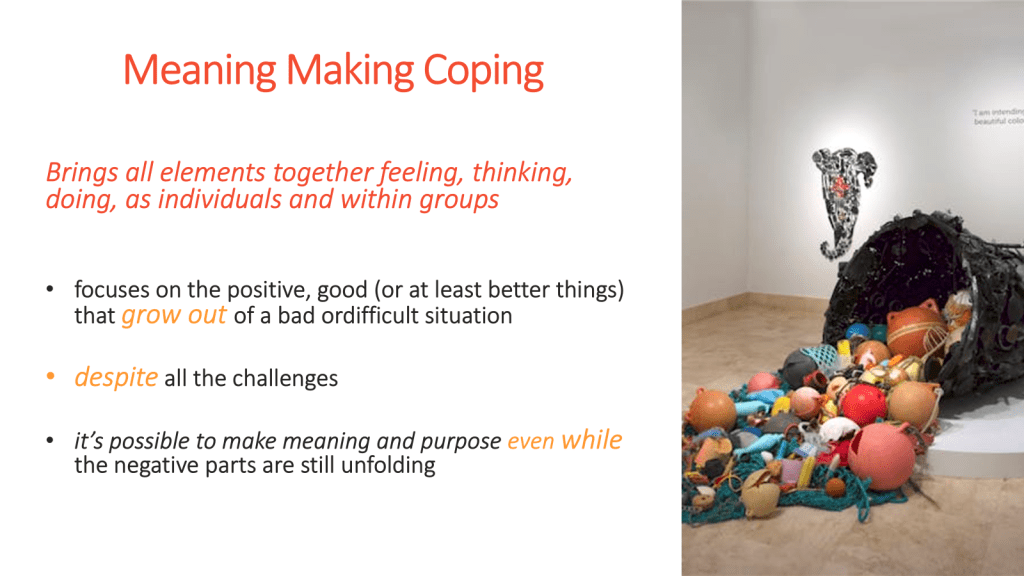
This is the idea that we can focus on new learnings, ideas, projects, actions and/pr goals – that build something positive or constructive out of the crisis, like in the picture above showing recycled plastic being turned into art.
It’s not that we skip over the hard or bad things happening. But instead, look at how we can use the challenges to forge something new, in spite of, or even as a result of, all the hard and bad things happening due to the bloom.
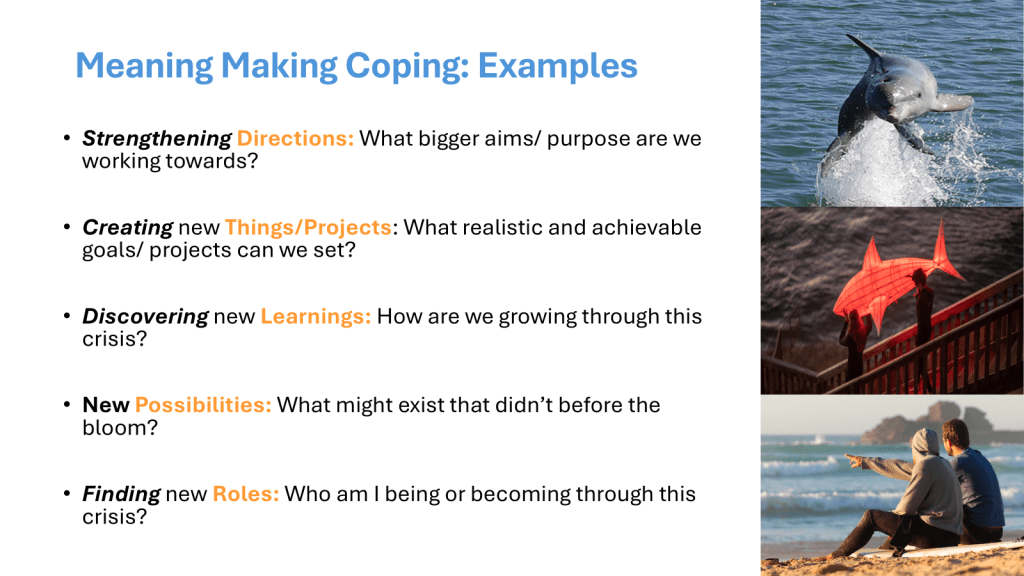
For great examples of making meaning coping during the algal bloom, go to: Finding Meaning and Purpose Through the Algal Gloom.
Here are some ideas of roles people have found during this crisis:
Thriving Through Connection to Nature and Art
Research is increasingly emerging about the mental health and well-being benefits of connecting to nature and through doing art.
Nature Connection
We can simply sit, walk and spend time noticing interesting things about nature, or we can get more actively involved in other nature-based activities, either alone or in groups,
Hiking and bush walking, bike riding, cannoning, camping or volunteering with land care groups, are just a few ideas for those able.

Art Activities
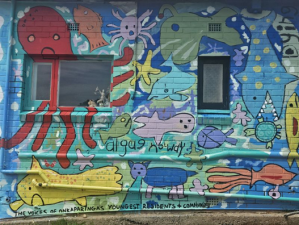
Crafts using natural materials or arts based on nature themes can be very good for settling the mind and emotions, as well as helping us come to terms with complex feelings and emotions that may have arisen as a result of the algal bloom.
Sometimes, putting our feelings about the algal bloom into art, drama, dance, music etc can help us express and make sense of things in way that words just sometimes can’t.
We can do art as a solitary activity or in groups, such as the community project depicted below (Toxic Surf, Good Bank Gallery mural project of local school children’s art).
These ways of coping may be especially important when it comes to coping over a longer period of time, should the algal bloom challenges continue over the summer and beyond.
For more ideas and activities on nature and art-based coping go to: Managing Climate Distress.
ALGAL ADAPTING
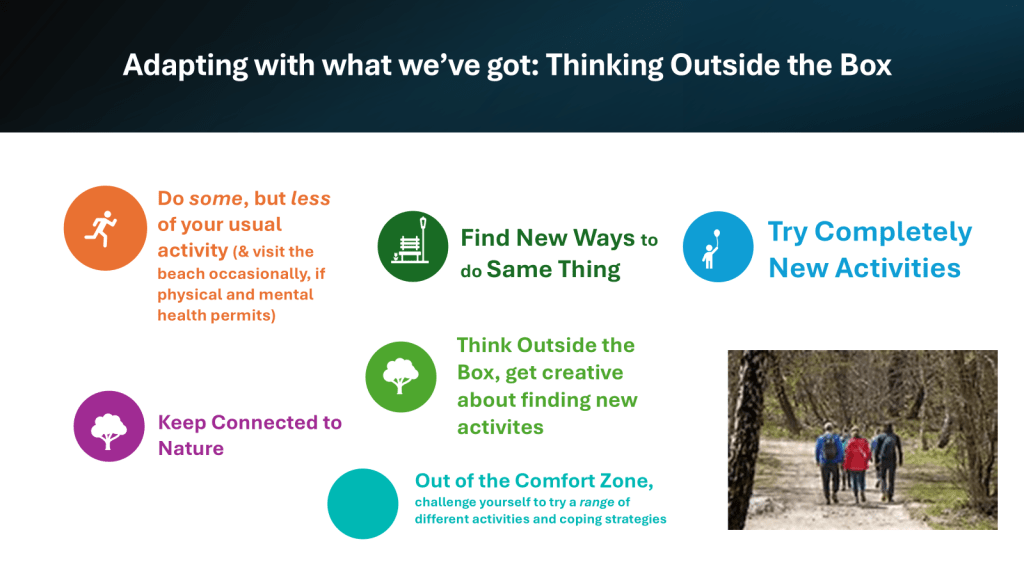
A final point. Many people are currently struggling with having lost their ‘happy or safe’ place. Some are feeling ‘out of sorts’ with their plans for summer having been disrupted. Some have even noted that they are struggling with their sense of identity, as it’s been strongly tied to their connection to the coast.
Below are a few things to consider with adapting to the necessary (hopefully, temporary) changes, particularly in recreational and lifestyle habits.

Key Points about Surviving and Thriving
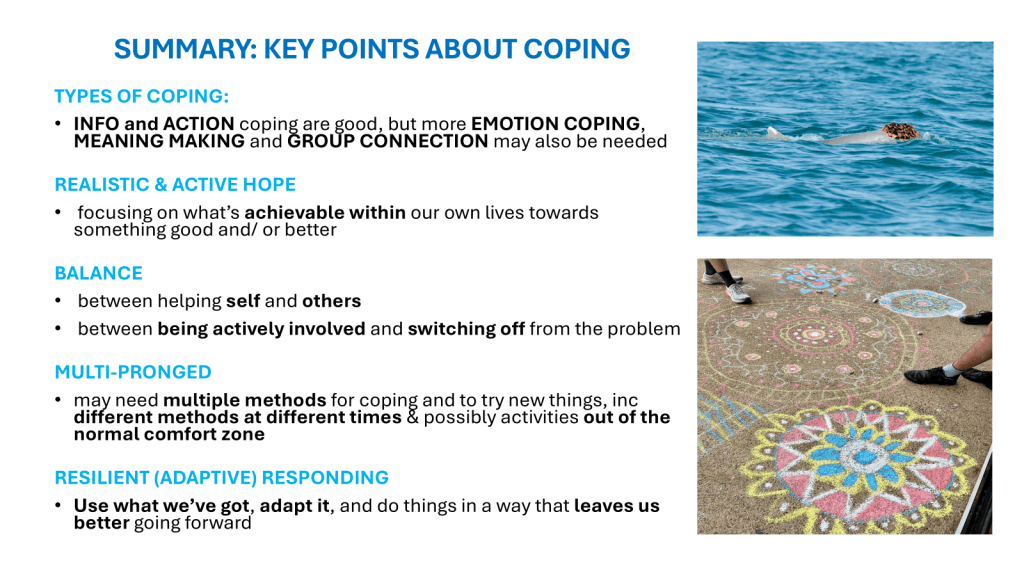
In summary, consider using a range of ways of coping – some that you may be less familiar or comfortable with, and some you may never have tried at all.
Now more than ever, is the time to stretch ourselves to learn new things, try new things, adopt new roles and become things we never might have dreamed of before this bloom.
Even though there are enormous challenges, if we can take on this struggle knowing we are not alone, perhaps we may even discover opportunities for growth and new hope, in spite of the algal agony and blooming gloom that’s all around.
Even though there are enormous challenges, if we can take on this struggle knowing we are not alone, perhaps we may even discover opportunities for growth and new hope, in spite of the algal agony and blooming gloom that’s all around.
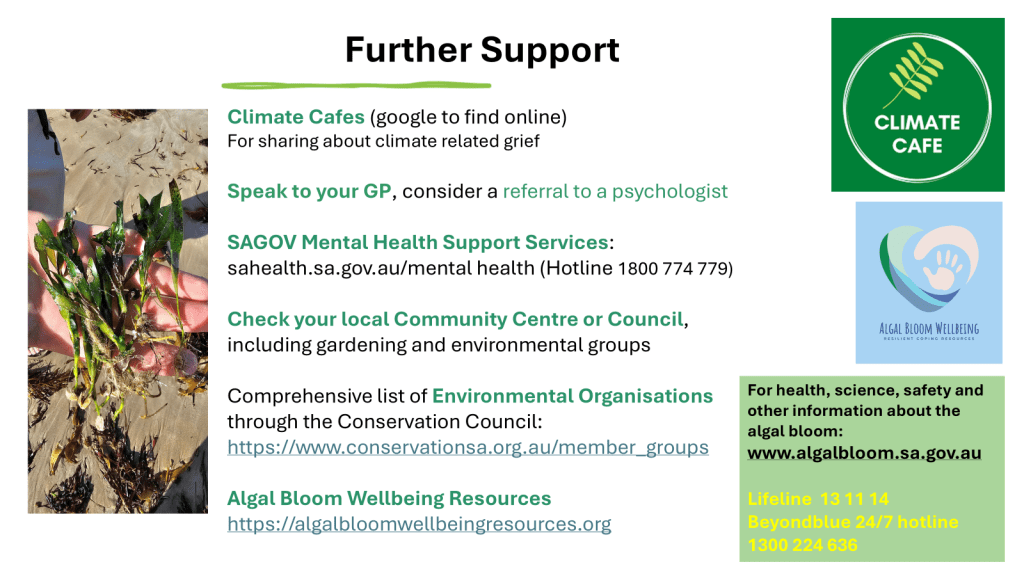
When and Where to Seek Extra Help
Of course, there are times when all of our best efforts may just not be enough to keep us afloat. For many different reasons, sometimes we will need extra support, and this is okay and completely normal at this time.
If you notice any of the signs listed above, please seek further support, as outlined below.
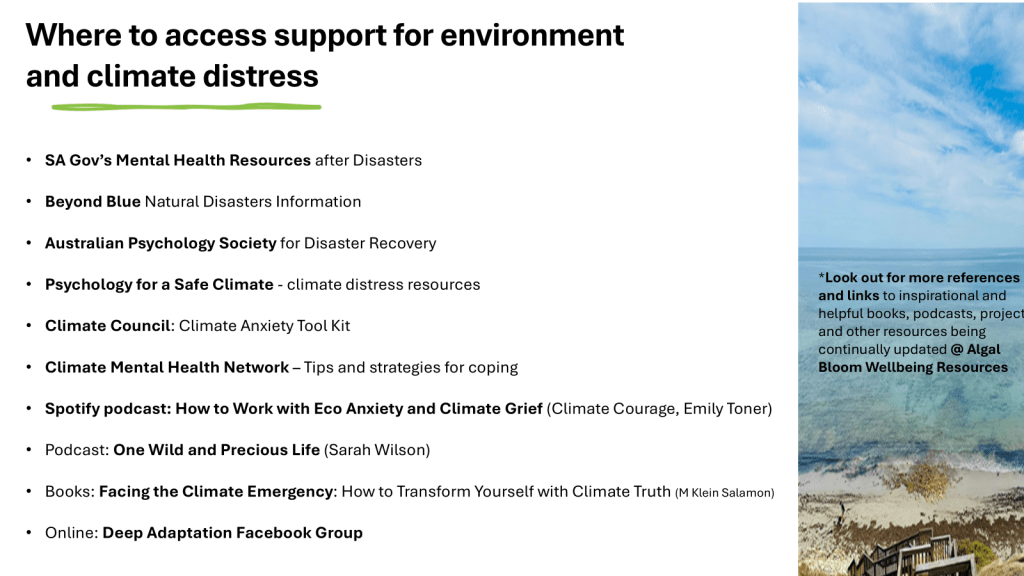
It is common in the community at the moment for people to be having more thoughts about climate-change and the future. Below are some useful resources to help with this.
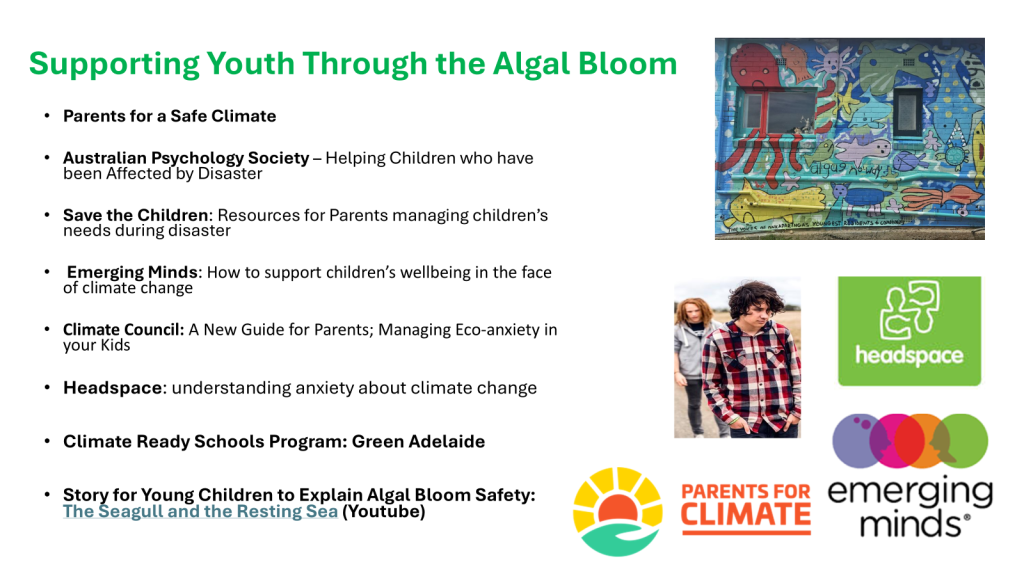
Finally, over the summer, many care-givers and educators will be supporting youth with their challenges relating to the algal bloom. Here are a few extra resources that may assist.
Find more information and links go to: Supporting Youth through the Bloom.
REFERENCES
Cardoso, M., & Harvey, S. (2024). Relationships are what Make Us: What the Community Resilience Program tells us about social connection and mental health in disaster-impacted areas, Relationships Australia Report.
Carlise, J. A., Mauseth, K. Clark, N. E. et al. (2014). Local Volunteerism and Resilience Following Large-Scale Disaster: Outcomes for Health Support Team Volunteers in Haiti, Int J Disaster Risk Sci (2014) 5:206–213
Clayton, S. Climate Change and Mental Health. Curr Envir Health Rpt 8, 1–6 (2021). https://doi.org/10.1007/s40572-020-00303-3.
Cruz, J., White, P. C. L., Bell, A. & Coventry, P. A. Effect of extreme weather events on mental health: A narrative synthesis and meta-analysis for the UK. International Journal of Environmental Research and Public Health 17, 1-17 (2020). https://dx.doi.org/10.3390/ijerph17228581
Lawrance, E. L., Thompson, R., Newberry Le Vay, J., Page, L. & Jennings, N. The impact of climate change on mental health and emotional wellbeing: A narrative review of current evidence, and its Implications. International Review of Psychiatry 34, 443-498 (2022), https://doi.org/10.1080/09540261.2022.2128725.
Leppold, C & Li, A. (2025). Long-term mental health trajectories across multiple exposures to climate disasters in Australia: a population-based cohort study. Lancet Public Health 2025; 10: e391–400
Longman, J., Braddon, M., Verlie, B., Schlosberg, D., Hampshire, L., Hawke, C., . . . & Saurman, E. (2023). Building resilience to the mental health impacts of climate change in rural Australia. The Journal of Climate Change and Health.
Mitchell, A., Maheen, H. & Bowen, K. (2024). Mental health impacts from repeated climate disasters: an Australian longitudinal analysis, The Lancet Regional Health – Western Pacific 2024;47: 101087, https://doi.org/10. 1016/j.lanwpc.2024. 101087.
Moreton M (2016), A study of four natural disasters in Australia: how the human response to fire, flood and cyclone contributes to community resilience and recovery. ANU Open Thesis Online.
Moreton, M (2018). ‘We needed help, but we weren’t helpless’: the community experience of community recovery after natural disasters in Australia, Australian Journal of Emergency Management,
Nieuwenhuijsen, M., Pretty, J. and Townsend, M, van Heezik, Y., Warber, S., Gaston, K. J. (2019). Nature–Based Interventions for Improving Health and Wellbeing: The Purpose, the People and the Outcomes. Sports 7, 141.
Patel, S., Robb, K., Pluff, C., Maldonado, E., Tatar, G., & Williams, T. (2021). Elevating mental health disparities and building psychosocial resilience among BIPOC children and youth to broaden the climate and health discourse. Journal of Applied Research on Children: Informing Policy for Children at Risk, 12(1). https://doi.org/10.58464/2155-5834.1457
Shanahan, D. F., Bush, R., Gaston, K. J., Lin, B. B., Dean, J., Barber, E., & Fuller, R. A. (2016). Health benefits from nature experiences depend on dose. Scientific Reports, 6(1), 28551.
Scheirich, C. (2020) Coping with the Climate Crisis: Exploring Art Therapy for Sustainable Mental Health. Graduate Project (Non-thesis). Concordia University. Concordia.
Whittaker, J., McLennan B. & Handmen, J. (2015). A review of informal volunteerism in emergencies and disasters: Definition, opportunities and challenges, Volume 13, September 2015, Pages 358-368,
https://www.sciencedirect.com/science/article/pii/S2212420915300388
 Algal Bloom Wellbeing Resources
Leave a comment